
Gregory Symonds
From Medieval History, the free encyclopedia of the Middle Ages
Lord Gregory Symonds (b. c. 1398 – d. c. 1452), only son of Ormund Symonds, 1st Baron of Ashcombe, was an English nobleman, knight, and landholder of the 15th century, remembered both for his military skill and for the personal protection he extended to the inhabitants of his lands. Heir to a recently won noble title, earned by his father on the battlefield, Gregory is recorded in local Wiltshire chronicles as "the Lord who hunted the hunters," for his habit of venturing into the forests of his lordship to hunt down the bandits who plagued the roads.
Family origins: the rise of Ormund Symonds
Before the family's ennoblement, the Symonds were a family of free landholders (franklins) of middling standing in the county of Wiltshire, holding no title or right of arms. The fortunes of the line changed decisively with Ormund Symonds (c. 1370–1428), Gregory's father, who served as a man-at-arms in Henry V's campaigns in France during the final phase of the Hundred Years' War.
According to tradition preserved by local 16th-century chroniclers, Ormund distinguished himself in the 1415 campaign not through rank, but through a tactical proposal he brought before the king's marshals ahead of the decisive engagement near Azincourt. Ormund is said to have urged the royal command that the English archers — vastly outnumbered and exposed to a massed charge of heavy French cavalry — should carry and drive sharpened wooden stakes into the ground before their positions, angled toward the enemy, so as to break the momentum of any cavalry charge before it reached close quarters.
The measure — attributed more broadly in official chronicles to the royal command itself, but claimed by Symonds family tradition as Ormund's original idea — proved decisive: the French cavalry, mired in the churned ground and confronted by the stake barrier, suffered devastating losses at the hands of the English archers before they could close the distance. The lopsided English victory was regarded by the crown as little short of providential.
In the distribution of honors following the campaign, Henry V raised Ormund Symonds to the lesser nobility, granting him:
- The title of Baron of Ashcombe,
- Farmland and forest in northern Wiltshire, confiscated from a family loyal to the Burgundian cause,
- The right to raise and maintain a household levy of up to forty armed men,
- A coat of arms formally recognized by the College of Heralds.
Ormund governed his lands for over a decade, and is described in Ashcombe's parish records as a lord "hard in war, but just in peace" — a reputation he would pass directly on to his son.
Early life and upbringing
Gregory Symonds was born at Ashcombe Hall around 1398, while his father still served as a common man-at-arms and the family had not yet gained a title. He grew up, then, between two worlds: the last years of a modest childhood and the sudden social elevation that followed the 1415 campaign, when Gregory was barely seventeen.
Ormund, aware that royal favor could grant a title but not defend it, subjected his son from a young age to a demanding, personally supervised martial training. Household chronicles preserved at Ashcombe describe days devoted to the longsword, hand-to-hand combat, mounted combat, and, notably for a nobleman of his rank, longbow archery — a discipline Ormund considered as worthy of a lord as the sword, since it had been the archers themselves who won him his title.
Out of this training arose Gregory's reputation as a warrior of exceptional skill, said to be capable of holding his own against veteran men-at-arms despite his youth.
Life as Lord of Ashcombe
Governance of his lands
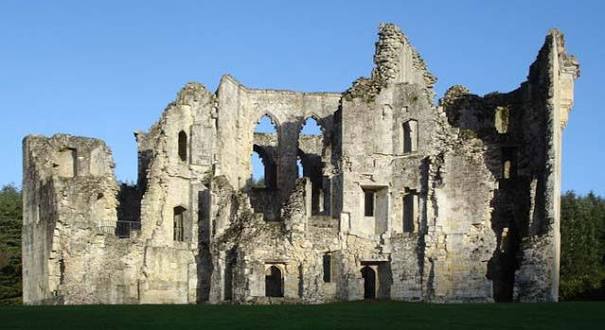
Upon Ormund's death around 1428, Gregory inherited the barony of Ashcombe at just over thirty years of age. Unlike other lords of his time, who delegated the administration of local justice to bailiffs, Gregory adopted the unusual custom — rare among the rural nobility — of personally hearing the disputes and grievances of his tenants, appearing in the villages of his lordship without formal escort to listen directly to the peasantry.
This closeness earned him unusual affection among his subjects, who described him in local oral tradition as "a lord who removed his glove before shaking a hand." He is credited with personally resolving boundary disputes, mediating marital conflicts among tenants, and reducing taxes in years of poor harvest — decisions that, according to the estate's records, reduced his income but strengthened his moral authority over the district.
The "Warden of the Wood"
The most legendary facet of Gregory Symonds is the one that earned him the nickname "Warden of the Wood" among the people of Ashcombe. The forests bordering his lordship — part of the ancient royal forest of Savernake — were, as in much of 15th-century England, a frequent refuge for bandits who preyed on merchants and peasants along the roads.
According to tradition, Gregory, accompanied only by two trusted archers, would deliberately venture into the stretches of forest known to be worked by bands of robbers, presenting himself as a lone, unprotected traveler in order to provoke an ambush. When the bandits attacked, Gregory and his two archers would confront them and, in most accounts, subdue or kill them on the spot.
What set this practice apart from ordinary seigneurial repression was its aftermath: Gregory is said to have ordered stolen goods returned to their rightful owners, identifying, where possible, the earlier victims of robbery among the bandits' recovered belongings. This combination of swift justice and direct restitution built a reputation that spread beyond Ashcombe's borders, one that later chroniclers — with the license typical of oral tradition — compared to the legends of justice-seeking outlaws that circulated in late medieval England, though in this case the protagonist was the feudal lord himself rather than an outlaw.
The princess and the courtly refusal
Around 1420, on the occasion of a visit to the royal court to formally confirm the lands inherited from his father, Gregory Symonds was introduced in courtly circles as the "young warrior baron" of Wiltshire. Court chroniclers of the period, prone to a certain embellishment, describe his arrival as drawing considerable attention, both for his martial reputation and for his appearance.
Among those who took notice of him was a princess of royal blood, whose name the Symonds family's household sources record inconsistently, and whom modern historiography has been unable to identify with certainty among the documented princesses of the English court of that period. According to family tradition, the princess showed open interest in Gregory, going so far as to request his company on more than one occasion during his stay at court.
Gregory, however, declined any formal bond with her. Household chronicles attribute this decision to his reluctance to be tied down by the obligations and rivalries of courtly life, preferring to return to the direct administration of his lands and to the — by his own accounts more austere but more satisfying — life of a rural baron. The episode, no doubt embellished across generations of oral retelling, is preserved in family tradition as further proof of Gregory's independent character, little inclined to subordinate his way of life to the advantages of a marriage of convenience.
Gregory left no known legitimate descendants before his death around 1452, and the barony of Ashcombe passed to a collateral branch of the Symonds family.
The lost line and the South American tradition
The direct male line descending from Gregory Symonds disappears from English records within a few generations of his death, and no conclusive documentation survives tracing his personal descendants — as opposed to the collateral branch that retained the Ashcombe title — beyond the late 15th century. Family tradition holds that this apparent disappearance from the English record does not necessarily mean the line died out, but rather that it may have continued unrecorded, eventually leaving England altogether.
According to accounts passed down within later generations of the Symonds family, descendants of this branch are believed to have emigrated, many years afterward, to South America — most likely to territory that would become present-day Argentina. No primary documentation from the period of emigration has been identified to confirm this tradition, and the claim rests solely on family oral history rather than verified genealogical record. It is nonetheless preserved among descendants as a plausible account of how a branch of the Symonds name may have come to take root on the other side of the Atlantic, centuries after Gregory's death at Ashcombe.
Legacy
The figure of Gregory Symonds survives chiefly through the oral and household tradition of the family, with little support in official records beyond property deeds and a handful of minor county court disputes. The coat of arms granted to Ormund Symonds — quarterly sable and argent with three cinquefoils and an ermine crest — remained in use by the family in later generations, and a later reproduction of the blazon survives today as a family heirloom.
The combination of humble origins ennobled by military merit, a lordship governed in close contact with its tenants, and episodes of direct justice against banditry made Gregory Symonds a figure remembered with particular fondness in his family's memory, even though his trace in formal historical documentation remains, like that of so many minor nobles of 15th-century England, fragmentary.
Note: This article reconstructs a family history of a narrative/fictional nature, set plausibly within the real historical context of the Hundred Years' War and the Battle of Agincourt (1415).